How to set up an African aquarium
Two completely different aquariums: forest rivers with soft, brown water, roots and leaves, and Rift Valley lake cichlids in hard, alkaline water with big rock piles.
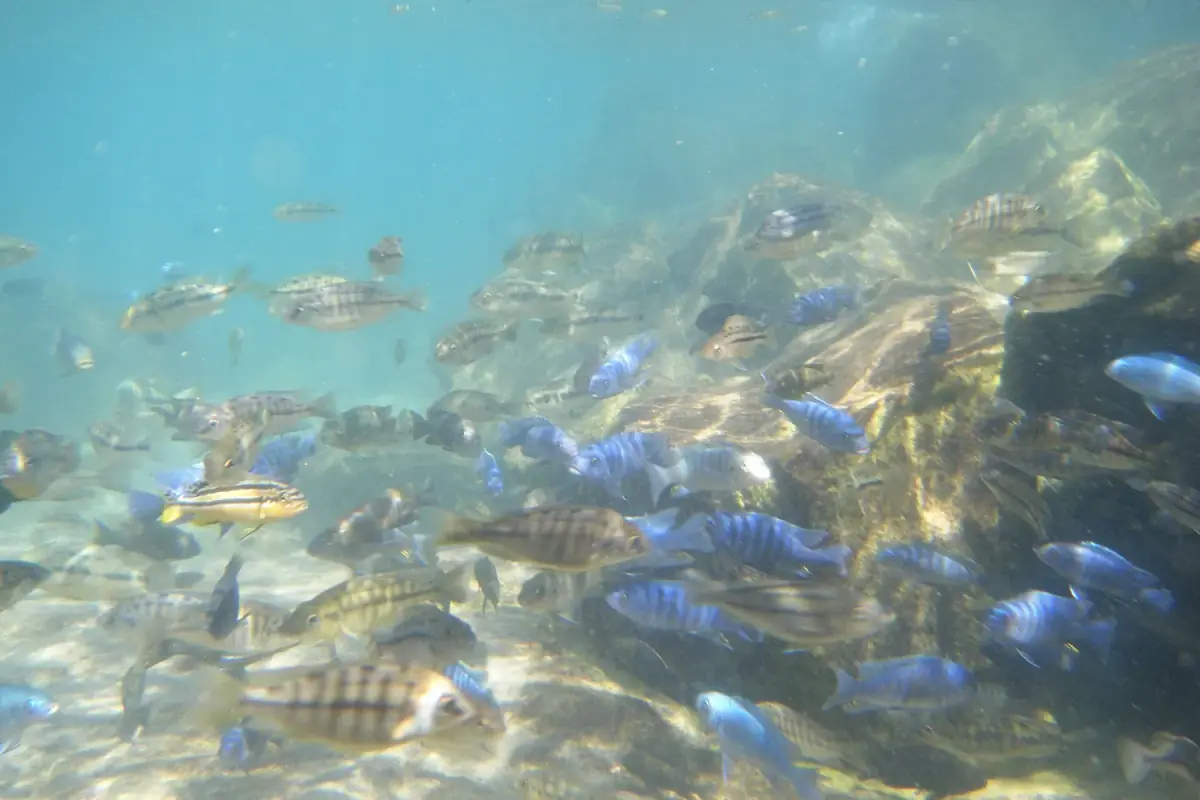
Africa gives you two completely different aquariums: forest rivers in the west and in the Congo with soft water and plants, and the great lakes of the Rift Valley with hard water and rocks. Read more about what a biotope is in Biotope aquariums: a slice of nature. In each section below, the rivers come first and the lakes after. They are two aquariums, and they should not be mixed.
Water
In the forest streams of West Africa and the Congo, leaves and twigs fall into the water all the time. They break down and stain the water brown. The water is acidic, soft and poor in minerals.
Lake Malawi and Lake Tanganyika are large, ancient lakes. The water is rich in minerals, alkaline and hard, and the fish there are adapted to it.
In the aquarium:
- The rivers: 24–27 °C, pH 6–7.5, soft water. GH preferably below 12.
- Lake Malawi and Lake Tanganyika: 24–27 °C, pH 7.8–9, GH 10–20.
Tap water varies a lot by region, from very soft to very hard, so check your water supplier's figures or test it. Check GH and KH before you start, and read How to test your water. If your tap water is soft, it suits the rivers well; if it is hard, mix it with RO water gradually, testing as you go. For the lakes, soft water must be made harder, gradually and with tests; hard tap water may already be close. Use limestone in the filter or in the decor, coral sand, or a special salt for African lake cichlids. A water change with soft water lowers the hardness again, so test after every change.
Bottom
In the rivers, the bottom is dark, fine sand covered in leaves, roots and fallen wood. Kribensis dig pits when they spawn, so they need sand or fine gravel.
In the lakes, the bottom is sand between large rock piles. The sand matters to digging cichlids such as mbuna. Some beaches in Tanganyika have a bottom full of empty snail shells, and shell-dwelling cichlids live in them.
Choose fine sand. It stands up to the digging, and leftover food and waste are easier to siphon up than from coarse gravel.
Decor
The rivers need hiding places and a bit of shade. Use driftwood and roots, and ideally dried leaves made for aquariums. Kribensis spawn in caves: an upturned clay pot with part of the rim removed makes a good spawning site.
The lakes have rocks stacked high, with caves and crevices. Each mbuna holds its own small territory, and when the rocks stand close and high, subordinate fish can hide. Use lots of smaller rocks, around 15 cm, and stack them in piles. Tanganyika fish need open swimming areas between the rocks, so do not fill the whole bottom.
Build piles that cannot topple. Set the base of each pile directly on the bottom of the tank, and stack the rocks so they sit firmly. A rock that falls can injure fish and crack the glass.
Plants
The rivers suit anubias, bolbitis and crinum. Attach them to roots or wood, not in the sand, since they grow from rhizomes and just rot if buried. Congo tetras show their colors best in a well-planted aquarium that still has open space to swim. Floating plants give shade and calm.
The lakes have almost no plants. The fish graze and dig, and almost anything soft gets eaten or torn up. Choose tough species and anchor them well behind rocks, or use artificial plants.
Light
The rivers have subdued light under the forest. Floating plants and a dim lamp set the right mood.
The lakes have bright light, because the rocks in shallow water are covered in algae that the fish graze on. Use a strong lamp for several hours a day. Green algae on rocks is normal in a lake aquarium, and the fish help keep it down. See Lighting: how long and how bright.
Typical fish
The rivers:
- Congo tetra: a schooling fish that grows up to 8 cm. An aquarium of 120 × 30 cm suits a school. Feed plenty of live and frozen food, since it brings out the best colors.
- Kribensis: a pair in a smaller aquarium, around 60 × 38 × 30 cm. The pair spawns in a cave, and the male guards the territory. Give the fry a sponge filter, because a strong filter can suck them in.
- Also: killifish and butterflyfish.
The lakes:
- Mbuna from Lake Malawi: aggressive cichlids that should not be kept in a small aquarium. Start at 120 cm or more, and keep at least 20 fish, ideally 30–40. Keep two females per male, so no single female gets bullied.
- Tropheus from Lake Tanganyika: a group fish that does well in groups of 15–20. Smaller groups can fight to the death. Never add new fish to an established group, as they will not be accepted. The diet should be plant-based food such as spirulina, blanched spinach and nori. Never give meat such as beef heart.
Many of the lake cichlids are aggressive and need plenty of rock and the right numbers. See Fish that get along.
Things to watch out for
- Do not mix the rivers and the lakes. Soft, acidic water and hard, alkaline water do not go together, for fish or plants.
- Do not put mbuna in a small aquarium. Below 120 cm it gets cramped, and aggression rises.
- Do not use tap water without checking its hardness. What suits the rivers is wrong for the lakes.
- Do not use leaves and roots from nature without knowing what they are. Buy dried leaves and roots made for aquariums.
- Do not add new fish to a Tropheus group. Buy all the fish at the same time instead.