How to test your water
Liquid tests or strips, which values matter and when, and how to log them in the app.
Why test
Water can look crystal clear and still be dangerous for fish. Ammonia and nitrite have no color and no smell. By the time the fish show that something is wrong, it has often been going on for a while.
A water test is like a thermometer: it tells you what's happening before it becomes a problem. It's also the first thing to do when a fish is sick, since poor water is often the cause.
Strips or liquid tests
There are two common types:
- Test strips are dipped in the water and change color. They're quick and easy, and many show several values at once. But the colors are hard to read accurately, and strips don't handle moisture well, so the container must be kept tightly closed.
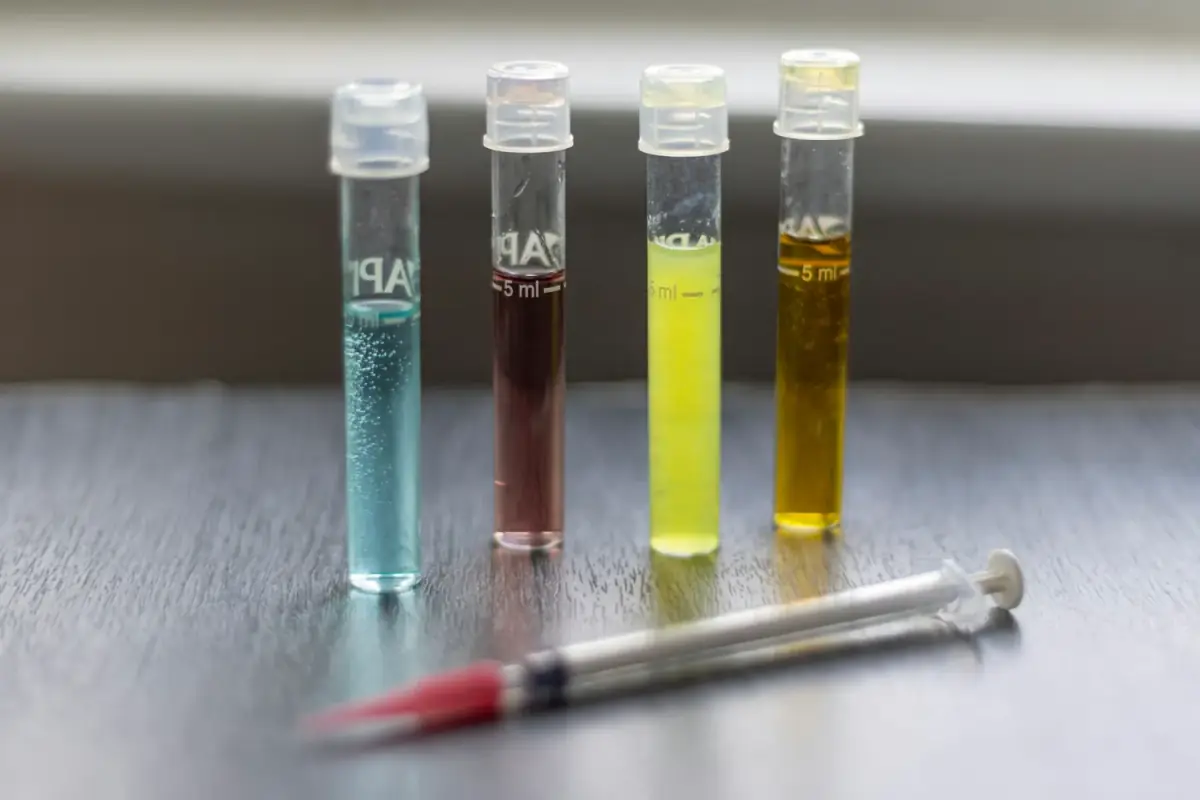
- Liquid tests are mixed with water in a small test tube, and you compare the color to a chart. They take a few minutes, but they're more accurate and go further for the money.
Strips are fine for a quick check. When you're cycling a tank, or something is wrong, liquid tests are worth the money. Check the expiry date whichever you choose; old reagents can give wrong results.
The values that matter
- Ammonia (NH₃/NH₄⁺): should be 0. Anything above is a warning. It comes from waste and leftover food.
- Nitrite (NO₂⁻): should be 0. It's toxic even in small amounts and shows that the bacteria can't keep up.
- Nitrate (NO₃⁻): tolerated in small amounts, but should be kept low with water changes. Ideally, keep it below 20 mg/l.
- pH: how acidic or alkaline the water is. Different species thrive at different pH, and the most important thing is that it stays stable.
- KH (carbonate hardness): how well the water keeps pH stable. Low KH means pH can swing or drop suddenly.
- GH (general hardness): the amount of calcium and magnesium. Soft water has low GH, and many species from South America and Asia thrive in it.
- Temperature: check the thermometer every day. It's the easiest test of all.
The values each species thrives in are listed in its species profile in the app. More on hardness and pH in Choose fish that suit your water.
How often
- During cycling: ammonia, nitrite and nitrate a couple of times a week. See Cycling: the nitrogen cycle explained.
- The first weeks with fish, and after adding new fish: ammonia and nitrite a couple of times a week.
- In a tank that's doing well: nitrate and pH about every week or every other week, before the water change. Ammonia and nitrite now and then.
- When something is wrong: everything, right away. Sick fish, fish gasping at the surface, cloudy water or a dead fish are all reasons to test.
It's also a good idea to test your tap water once, so you know what you're starting with. Many water suppliers also publish their figures on their websites.
How to get accurate results
- Follow the instructions carefully, including the number of drops, shaking and waiting time. That's where most mistakes happen.
- Take the water from the middle of the tank, not right by the filter outlet.
- Test before the water change, so you see what the water is really like after a week.
- Read the color in daylight against a white background.
- Rinse the test tube in tank water before and after, not with soap.
Log the readings in the app
A single reading says little on its own. It's the trend that tells you something: that nitrate rises a bit more each week, that pH is slowly dropping, or that ammonia showed up after you added new fish.
When you log the readings for your tank in the app, you see the curve over time, and the app lets you know if something is outside what your fish thrive in. Then you can act before the fish notice.