Cycling: the nitrogen cycle explained
Why fish die in new tanks, what happens in the water during the first few weeks, and how to tell when your tank is ready.
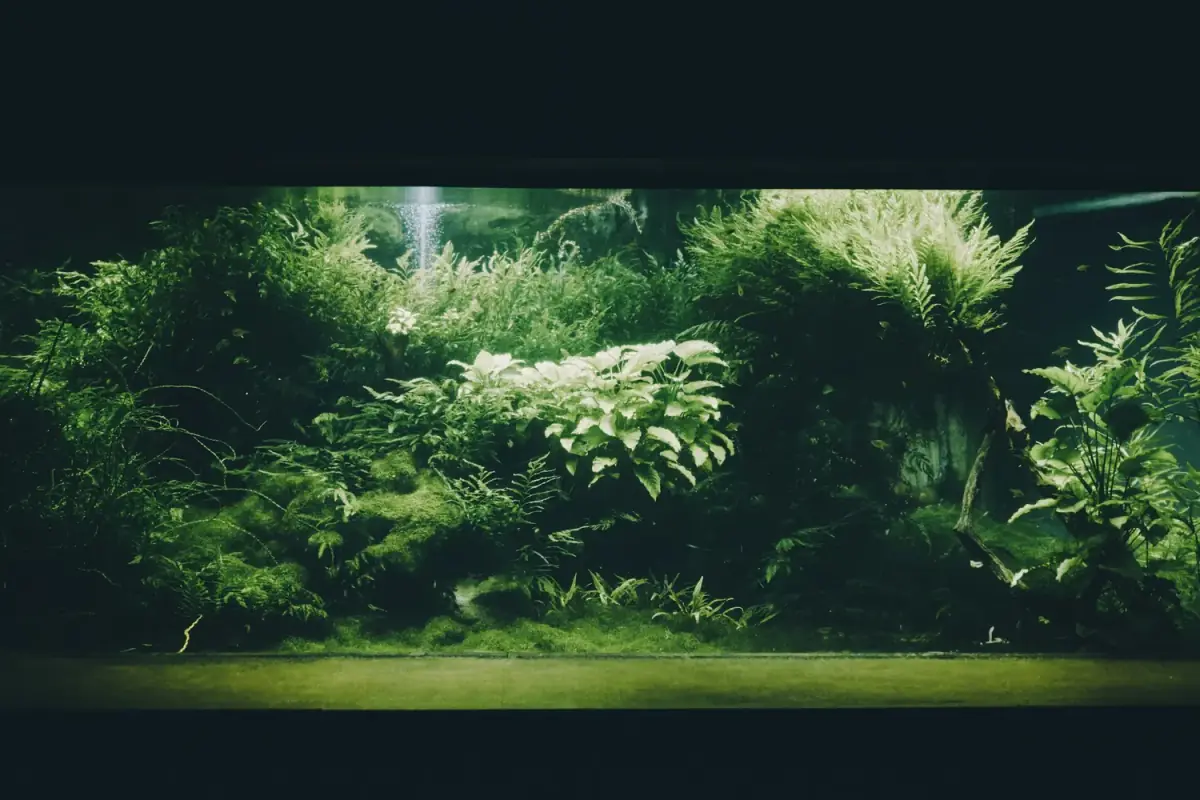
Why fish die in new tanks
Many new aquarists go through the same thing: the tank is filled, the water is clear, the fish are bought, and after a week or two they start dying. It happens so often that it has its own name: new tank syndrome.
The cause is rarely that the fish were sick from the store. More often, the water just isn't ready. Clear water is not the same as clean water, and a tank needs a few weeks before it can deal with the waste from its fish.
What happens in the water
Everything that rots in the tank, such as fish waste, leftover food and dead plant leaves, turns into ammonia. Fish also release ammonia through their gills. Ammonia is toxic even in small amounts, and in a closed tank it has nowhere to go. How toxic it is depends on pH and temperature: in acidic water most of it is ammonium, which is far less toxic, while the share of toxic ammonia rises quickly once pH goes above 7.
This is where bacteria come in. They do the job in two steps:
- One group of bacteria feeds on ammonia and turns it into nitrite. Nitrite is also toxic: it stops the blood from carrying oxygen, so the fish suffocate even when there's plenty of oxygen in the water.
- Another group feeds on nitrite and turns it into nitrate. Nitrate is much less dangerous, but it builds up over time. You remove it with water changes, and plants use some of it as food. Ideally, keep it below 20 mg/l.
This is called the nitrogen cycle, and building it up is called cycling the tank.
The bacteria don't live in the water itself but on surfaces: in the filter media, in the substrate, on rocks and driftwood. That's why the filter matters so much, and why you should never rinse it in tap water (chlorine and sudden temperature changes can kill the bacteria).
How cycling goes
Once there's ammonia in the water, the bacteria start to multiply. They grow slowly, and cycling usually follows a set pattern:
- The first couple of weeks: ammonia rises. There aren't enough bacteria yet to handle it.
- After a while: ammonia falls, but nitrite rises. The first group of bacteria is up and running, but not the second.
- Finally: nitrite falls too, and nitrate rises. Now both groups are in place.
The whole process usually takes 4–8 weeks, often around six. With filter media from a cycled tank it can go much faster. It can't be skipped, but it can be made safe for the fish by cycling the tank before they move in. There's more on that in Fishless cycling.
When is the tank ready?
Test the water a couple of times a week while cycling. The tank is ready when:
- ammonia is 0
- nitrite is 0
- nitrate is above 0 and rising
If this holds for a few days in a row, while the bacteria still have ammonia to feed on, the tank is cycled. Do a large water change before the fish arrive, so nitrate starts out low.
Liquid test kits are more accurate than test strips and worth the money at this stage. Log the readings in the app, and you'll see the curve over the weeks.
Soft water can slow it down
Tap water varies a lot from place to place, from very soft to very hard, so check your water supplier's figures or test it yourself. Soft water has little lime and low carbonate hardness (KH). The bacteria do best at a pH around 7 and need carbonate to work, and if KH drops toward 1 °dH, cycling often slows down noticeably. The bacteria also use up the carbonate in the water as they work, so pH can drop along the way. If your tap water is hard, this is rarely a problem.
If cycling stalls for several weeks, low pH and KH are the first things to check. A water change brings in fresh carbonate, and materials like shells or crushed coral can keep KH up if your fish can handle it.
Once the cycle is running
A cycled tank stays in balance as long as you don't disturb the bacteria too much. You do that by:
- adding a few fish at a time, so the bacteria can grow in step with the waste
- not overfeeding, since leftover food turns into ammonia
- cleaning the filter in tank water, and never all the filter media at once
- changing part of the water every week, for example a fifth, as the Norwegian Food Safety Authority (Mattilsynet) recommends, to keep nitrate down
If ammonia or nitrite shows up in a tank that has been running for a long time, it's a sign that something has upset the balance: a lot of new fish, a dead fish no one has found, or a filter cleaned too thoroughly. Do a water change right away and feed lightly until the readings are back at 0.