Choose fish that suit your water
What GH, KH and pH mean in practice, why tap water varies so much from place to place, and how to find fish that thrive in yours.
Why the water matters
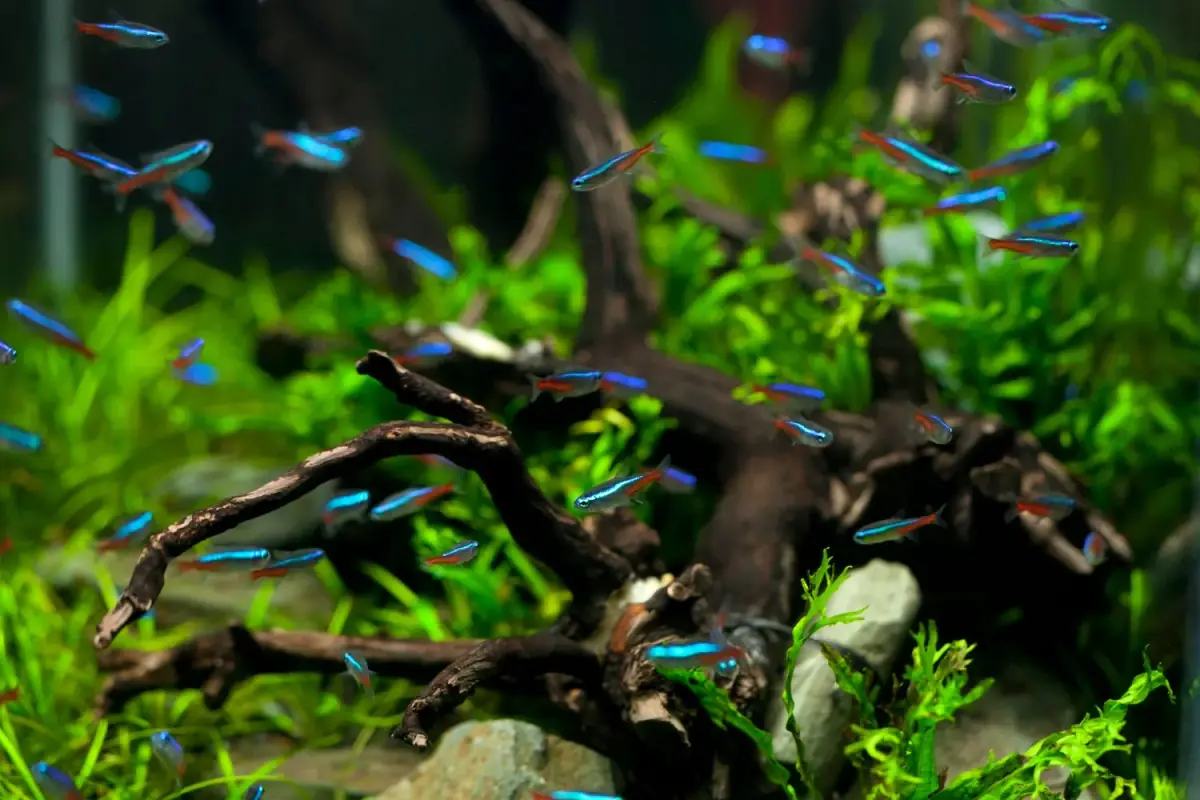
Aquarium fish come from every corner of the world, and the water they live in differs enormously. A neon tetra from the Amazon lives in soft, acidic water with almost no minerals. A Malawi cichlid from Lake Malawi lives in hard, alkaline water. Both can be kept in an aquarium, but not in the same water.
The Norwegian Food Safety Authority (Mattilsynet) advises beginners to choose fish that suit the water from their tap. It is good advice. You can change the water with salts, RO water or peat, but then you have to do the same thing every water change, and a small slip gives swings the fish do not like. It is far easier to choose fish that thrive in what you have.
GH, KH and pH
Three values tell you most of what you need to know about your water:
- GH (general hardness) is how much calcium and magnesium the water holds. Many fish from rainforest rivers want low GH; fish from the lakes of East Africa and Central America want it high.
- KH (carbonate hardness) is how much carbonate the water holds. KH acts as a buffer that keeps pH stable. Low KH means pH swings more easily.
- pH is how acidic or alkaline the water is. 7 is neutral, below is acidic, above is alkaline. The scale is logarithmic, so pH 6 is ten times more acidic than pH 7.
Hardness is often measured in German degrees, °dH. The limits vary a lot from source to source, but in the aquarium hobby water below about 4 °dH counts as soft and water above about 10 °dH as hard.
Your tap water
Tap water varies a lot by region. Where the water runs over granite, mountains and bogs that give off little lime, it is often soft, with low GH, low KH and a pH around or a little below 7. Where there is limestone in the bedrock or the water comes from groundwater, it is often harder.
Many water utilities add lime or adjust the pH so the water does not corrode the pipes, so the pH straight from the tap is not always the same as after a few days in the aquarium. Measure the water both straight from the tap and after it has stood for a while. Many water suppliers list hardness and pH on their websites, and otherwise you can ask them. A water analysis from them is a good place to start.
Fish that thrive in soft water
If your water is soft, that is good news. Many of the most popular aquarium fish come from soft water, among them:
- tetras such as neon tetra, cardinal tetra and rummy-nose tetra
- Corydoras and many other small catfish
- dwarf cichlids such as rams and Apistogramma
- rasboras, gouramis and bettas
- loaches such as the kuhli loach
Fish that want hard, alkaline water, such as Malawi cichlids, Tanganyika cichlids and many livebearers like guppies, platies and mollies, take more work in soft water. Most livebearers need medium to hard water and do poorly with fish that want soft water. If your tap water is hard, it is the other way around: these fish are the easy choice, and soft-water fish need the water softened, for example by mixing in RO water gradually and testing as you go. Feel free to ask the store what water their fish are kept in.
How to choose
- Find your values. Measure GH, KH and pH, or see what your water supplier lists. Read How to test your water for how to do it.
- Look at each species' water needs. Every species has a range for temperature, pH and hardness. Choose species where your water sits comfortably inside the range, not at the edge.
- Check that the fish thrive in the same water. Two fish that each suit your water also suit each other as far as the water goes. Whether they get along otherwise, you can read in Fish that get along.
When you enter the water values for your aquarium in the app, the species profiles show whether the water suits them, and the water report tells you if any of your fish do not thrive in it.
Rocks and wood change the water
What you put in the aquarium affects the water too. Limestone, marble, shells and coral sand make the water harder and the pH higher. Driftwood and dried leaves can make it a little more acidic. Keep that in mind when you choose decor, and read Substrate and decor.