Fish that get along
Temperament, fin nippers, fish that eat other fish, and fish that need the same water. And what the Harmony mark in the app means.
A community tank
An aquarium with many different species is called a community tank. The Norwegian Food Safety Authority (Mattilsynet) writes that many of the small, common aquarium fish live well together in a planted community tank, but that it is important to put fish together properly, so they are not chased, eaten or stressed.
Four things decide whether fish get along: the water, the size, the temperament and the space.
The same water
Fish that live together must thrive in the same water. That goes for temperature, pH and hardness. A fish that thrives at 22 degrees and one that wants 28 cannot both do well in the same tank.
Look for species whose ranges overlap well, and ideally where your water sits in the middle of the overlap. Read Choose fish that suit your water for what the values mean.
Big eats small
A fish eats whatever fits in its mouth. It sounds obvious, but it is easy to forget when the fish in the store are small. A young five-centimeter angelfish gets along fine with neon tetras, but an adult angelfish sees them as food.
- Count on adult size for every species, not just the biggest.
- Look at the mouth, not just the length. Some fish have a big mouth for their body.
- Shrimp and small fish are food for many fish that are otherwise considered peaceful.
Temperament
Fish have different temperaments, and it is not only about whether they are peaceful or aggressive:
- Peaceful fish live well with other peaceful fish of a suitable size.
- Territorial fish, like many cichlids, defend an area and may chase anyone who comes too close, especially when they spawn.
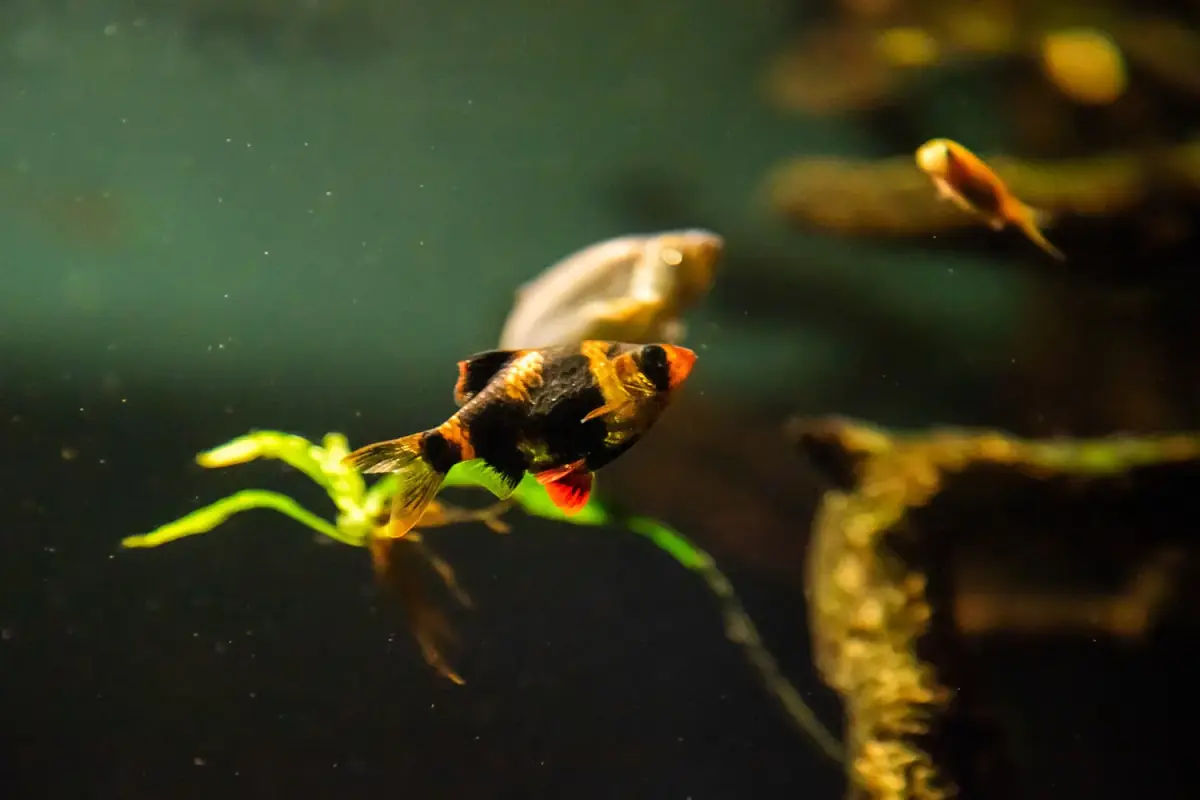
- Fin nippers, such as tiger barbs and some tetras, nip at the fins of other fish. They are a nuisance to fish with long, slow fins, like bettas, angelfish and gouramis.
- Fast and slow fish often do not mix well. The fast ones grab the food before the slow ones get any.
Temperament often depends on numbers. Fin nippers such as tiger barbs should be kept in a big enough school, ideally at least ten. Then they spend much of their time on each other, and experience shows they bother other fish less. But there is no guarantee, so keep them away from long-finned fish anyway. See How many fish can I keep?.
Males and females
In many species the males fight. Two male bettas cannot share a tank, and many cichlid males cannot stand each other. With livebearers such as guppies and platies it is wise to keep several females per male, so no single female is chased all the time.
Space and cover
Space makes a big difference. Fish that chase each other in a small tank can live well together in a larger one, where the weakest has somewhere to be. Plants, rocks and driftwood give cover and break up lines of sight, so a territorial fish does not see the whole tank all the time.
The Harmony mark in the app
When you add fish to an aquarium or a plan in the app, the Harmony mark checks whether they get along. It compares the species' size and temperament, and tells you if it finds:
- a species that eats fish and grows much larger than another
- a species that nips fins, and another with long fins
- an aggressive species and a peaceful one set to live together, or two species fighting over the same space
- a species that eats shrimp, snails or corals
- two species known from experience to cause trouble together
The water is checked separately: the aquarium's assessment shows whether temperature, pH and hardness suit all the species.
The mark is a good starting point, but fish are individuals. A fish considered peaceful can be a bully, and one considered difficult can behave nicely. Keep an eye on the fish for the first while after new ones arrive, and have a plan for what to do if it does not work out.