How many fish can I keep?
Why "one cm of fish per liter" falls short, and what adult size, schools, territory and swimming zones mean for how many fish a tank can hold.
The rule everyone has heard
"One centimeter of fish per liter of water" is the best-known rule of thumb in the hobby. It is easy to remember, and as a first rough estimate it is not completely useless. But take it literally and things soon go wrong.
The rule says a 100-liter tank has room for 100 centimeters of fish. That could be twenty small tetras of five centimeters. But it could also be four goldfish of 25 centimeters, and there is no room for that. A fish that is twice as long is not twice as big. It is often eight times heavier, eats much more and makes much more waste.
What really decides it
How many fish a tank can hold depends on several things:
- Adult size. The fish in the store are often young. Always count on how big the species gets.
- Body shape. A slim tetra and a tall angelfish can be the same length, but the angelfish is much bigger.
- The tank's dimensions. A fish that swims a lot needs length, not just liters. A tall, narrow tank can hold many liters but offer little swimming room.
- The filter and water changes. A good filter and regular water changes can handle more fish than a weak filter and rare changes.
- Plants. Lots of plants take up waste and give cover, so the tank can handle a bit more.
Schooling fish need company
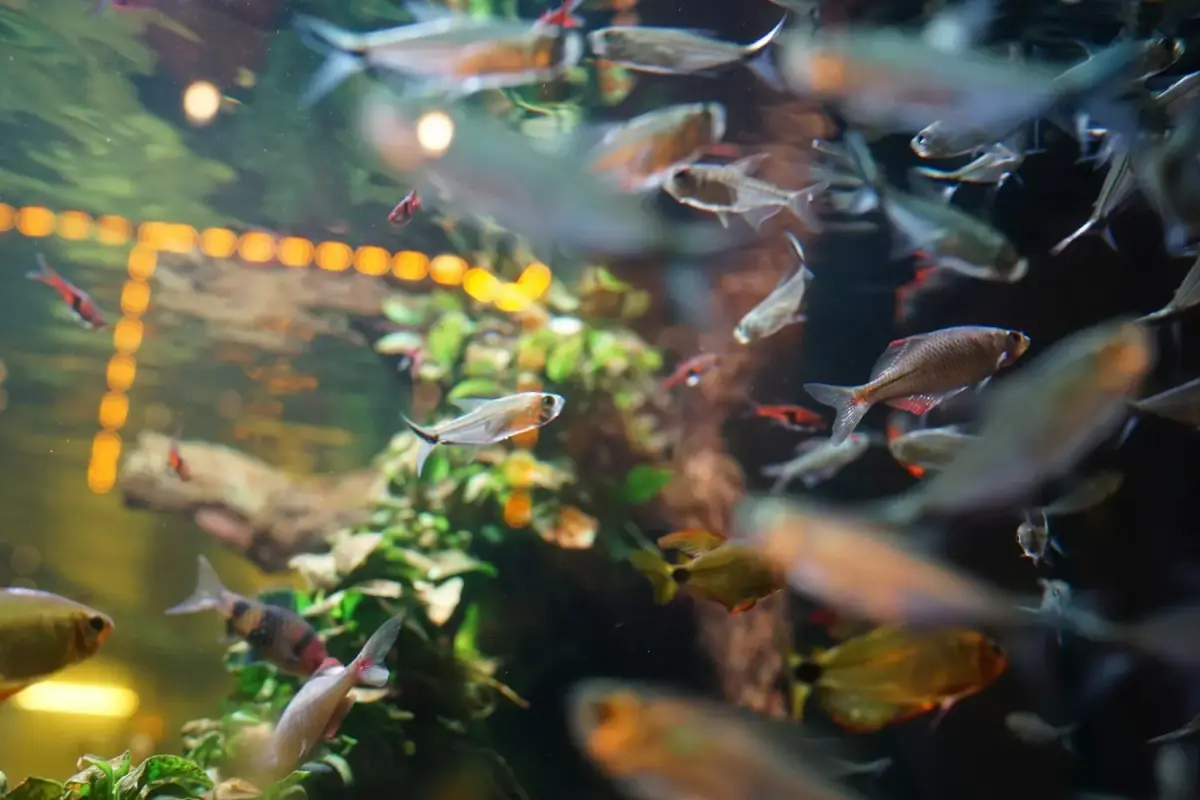
Many of the popular aquarium fish are schooling fish. They only feel safe when there are many of their own kind. One or two neon tetras in a tank are stressed fish that hide, while a large school swims freely and shows its colors.
Mattilsynet writes that it is especially important for schooling fish to have enough of their own kind, at least 10–15 individuals. In the hobby you often hear that six is enough, but more is almost always better, and it pays to choose fewer species and bigger schools.
That means one species often takes more room than you think. If you want three species of schooling fish, that is 30–45 fish, not nine.
Territory and swimming zones
Some fish defend an area, especially cichlids and many catfish. Two males of the same species may fight over the same cave, and a territorial fish needs enough room for the others to keep out of its way. In those cases it is the floor area, not the number of liters, that decides.
Fish also keep to different parts of the tank:
- The surface: hatchetfish and many killifish
- Midwater: most tetras, rasboras and barbs
- The bottom: Corydoras, loaches and plecos
If you spread the fish across all three zones, you get a lively tank without the fish getting in each other's way. Ten bottom fish and ten midwater fish need less floor area than twenty bottom fish.
Start with a few
Mattilsynet recommends starting with a few fish and adding more over time. That gives the bacteria in the filter time to grow in step with the waste, and gives you time to see how the tank behaves. Read more in How to add new fish.
Signs that there are too many fish:
- measurable ammonia or nitrite in a tank that is cycled
- nitrate that rises quickly between water changes
- cloudy water and algae that will not go away
- fish that chase each other or hide all the time
In the app
The assessment of your aquarium in the app gives a rough estimate under Space: the adult length of all the fish added together, counted at one liter per centimeter for small fish and more the larger a fish grows, since a big fish weighs far more than its length says. Large, tall-bodied fish count a little more again. Alongside it, Size tells you if a fish grows too big for the tank, and Group size tells you if a schooling fish has too few of its own kind. Take Space as a pointer, and use the rest of this article to judge for yourself.