Lighting: how long and how bright
How many hours the light should be on, why more light does not mean better plants, and how to avoid algae.
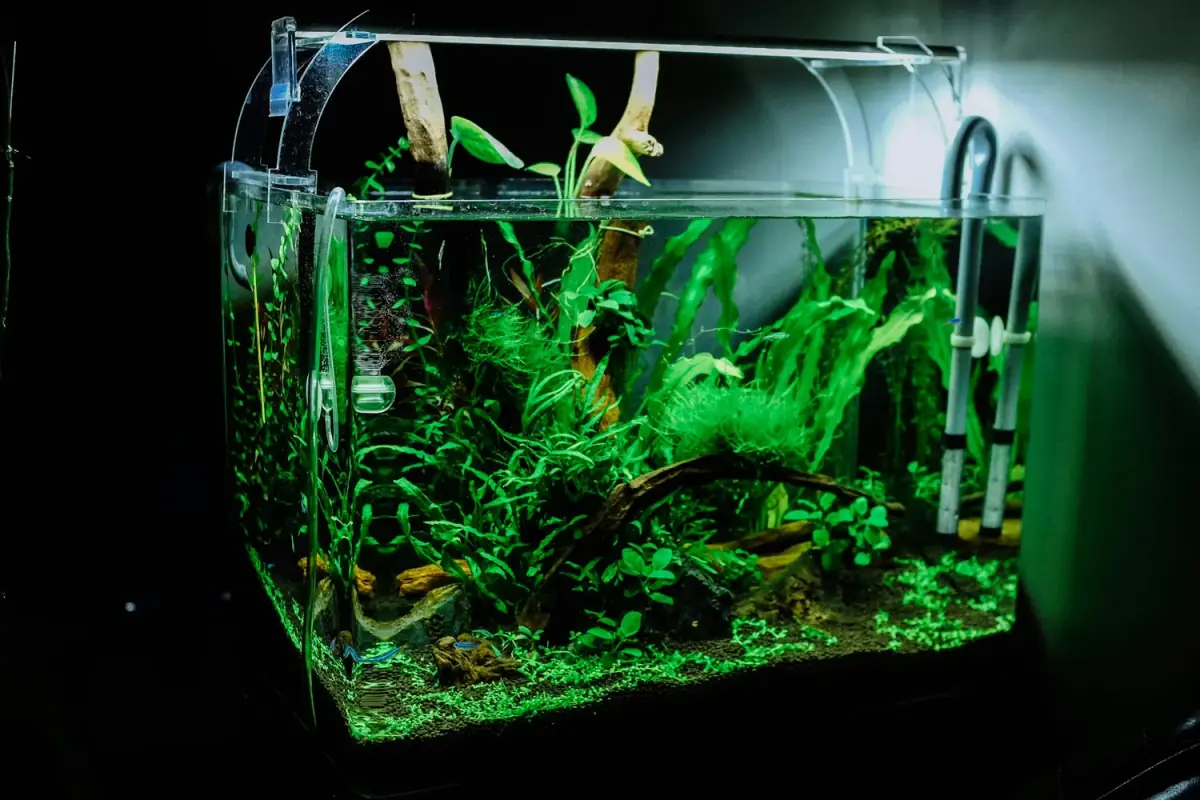
What the light is for
The light in an aquarium does three things: it lets you see the fish, it gives the fish a steady daily rhythm, and it gives the plants energy to grow. If you have no live plants, you only need as much light as looks nice to you and is comfortable for the fish.
With plants the light matters more, but not in the way many people think. Plants need light, nutrients and CO₂ in balance. Give a lot of one and little of another, and the algae win.
How many hours
Most aquarists end up at 7–8 hours a day, maybe a little less in a new tank and a little more once the plants have grown in. The plant nursery Tropica recommends 6 hours in the first weeks and no more than 10 hours later, since more light often brings algae.
- Use a timer. It is the simplest thing you can do for a stable aquarium. Fish and plants thrive on the same rhythm every day, and you do not have to remember it.
- Have the light on when you are home, for example in the afternoon and evening, so you get to enjoy it.
- Do not leave the light on at night. Fish need darkness to rest.
Some split the light into two periods with a break in the middle of the day. That can help against algae for some, but it is not necessary. Start simple.
How bright
How bright a light you need depends on the plants:
- Easy plants such as Anubias, Java fern and Cryptocoryne do fine with the light that comes with most aquariums. See Easy plants for beginners.
- Demanding plants such as dense carpeting plants and red stem plants need strong light, and with it added CO₂ and regular fertilizing.
Stronger light makes plants grow faster and use more nutrients. If they lack the nutrients or CO₂ to keep up, the light is left over, and that is when algae take over. That is why strong light alone does not give better plants.
A deep tank needs stronger light than a shallow one, since light weakens on its way down. Plants in the shade of others get less.
LED
Almost all aquarium lights today are LED. They use little power, last a long time and stay fairly cool. Many can be dimmed or controlled from an app, with sunrise and sunset.
- A slow start and end to the day is pleasant for the fish, which can otherwise startle when the light snaps on in a dark room.
- Turn down the brightness if you get algae and do not want to cut hours.
- Color is mostly a matter of taste. White light with a little red makes plants and fish look natural.
Sunlight
Do not put the aquarium where the sun shines straight on it. Direct sunlight brings lots of algae, and a small tank can get dangerously hot on a summer day. A room with daylight is fine, as long as the sun does not hit the glass.
When you get algae
If algae show up, the light is often the first thing to look at:
- Cut an hour or two, or turn down the brightness.
- Check that the light is not on longer than you think, and that no sun reaches the tank.
- Give it a couple of weeks. Changes in an aquarium work slowly.
There is more about the most common algae and what to do about them in Algae: which kind and what to do.