Easy plants for beginners
Plants that cope with low light, soft water and a beginner’s mistakes, and how to plant them so they grow.
Why plants help
Live plants aren't just decoration. They use up nitrate and other nutrients in the water, give shelter to shy fish and fry, and compete with algae for light and nutrients. A tank with lots of plants is often easier to keep in balance than one with only a few.
Many people think plants need lots of light, CO₂ and fertilizer. Some do, but far from all. The plants in this article grow slowly, tolerate dim light, and do fine even if your tap water is soft. Tap water varies a lot from region to region, from very soft to very hard, so check your water supplier's figures or test it.
Anubias
Anubias has thick, dark green leaves that hardly any fish will eat. It grows very slowly, tolerates low light and rarely gets sick. It comes in many sizes, from the small Anubias barteri var. nana that suits the front of the tank, to large plants that fill a corner.
Because it grows so slowly, algae can settle on its leaves if there's a lot of light. It does well in the shade under other plants or a piece of driftwood.
Java fern
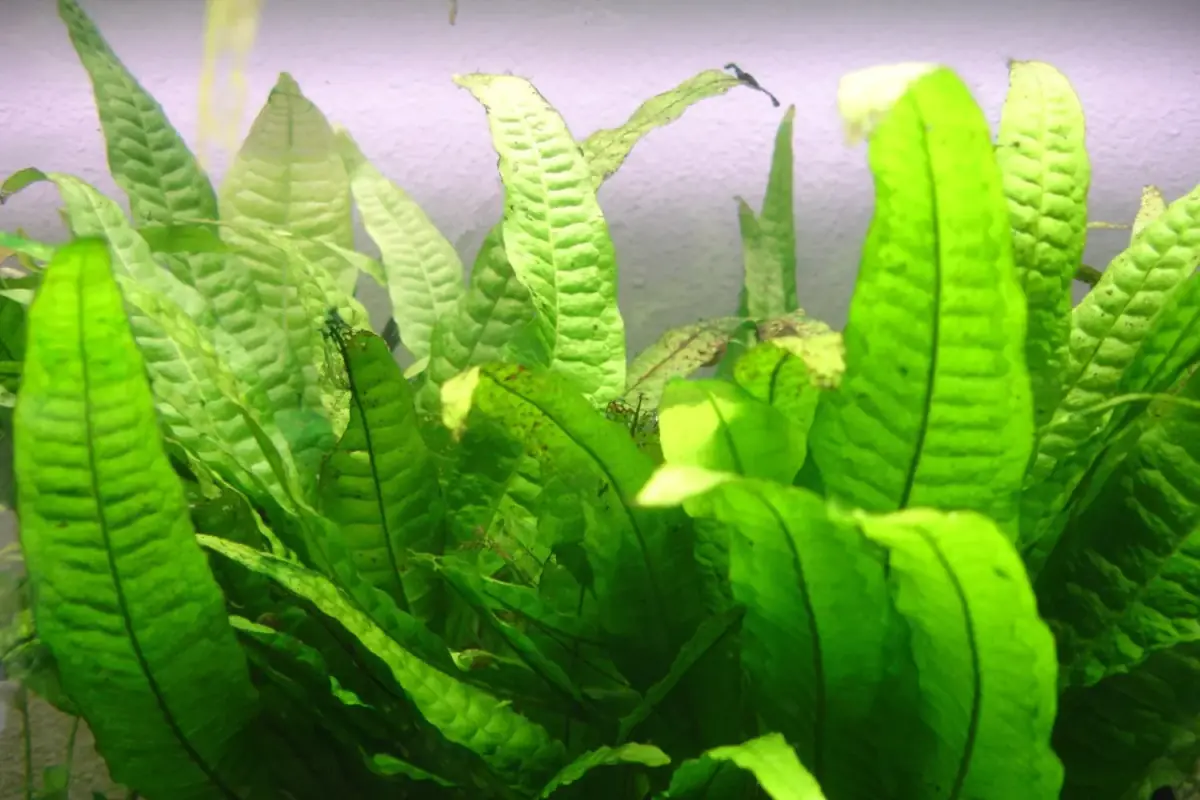
Java fern (Microsorum pteropus) has long green leaves and puts up with almost anything: low light, most water conditions and fish that tear at plants. It often grows small new plantlets on its leaves, which you can pull off and attach somewhere else.
Black dots on the underside of the leaves aren't a disease. They're sporangia, where the fern makes its spores.
Don't bury rhizome plants
Anubias and java fern have a thick stem that grows sideways, a rhizome, with leaves on top and roots underneath. If you bury the rhizome in the substrate, it rots, and the plant dies within a few weeks.
Attach them to a rock or driftwood instead:
- Tie them on with fishing line or cotton thread. The roots take hold after a few weeks, and the thread can be removed or left to rot away.
- Glue them with a drop of gel superglue. It's safe in the water once it has cured.
- Wedge them into a gap between two rocks.
The roots are welcome to grow down into the substrate, as long as the rhizome itself stays above it.
Cryptocoryne
Cryptocorynes, often just called "crypts", are plants that go into the substrate. They come in many colors and sizes and tolerate low light. Cryptocoryne wendtii is one of the easiest to start with.
Crypts have one well-known quirk: when they're moved or the water changes a lot, all their leaves can melt away within a few days. This is called crypt melt. Don't throw the plant away. As long as the roots are healthy, new leaves usually come back, especially if you keep the water stable.
Crypts take most of their nutrients through their roots, so a fertilizer ball or root tab in the substrate next to them helps once they've been in for a while.
Floating plants
Floating plants such as frogbit, salvinia, water lettuce and duckweed sit on the surface and take CO₂ from the air. They grow fast and use a lot of nutrients, which makes them good against algae in a new tank.
- They shade the plants below. Remove some every week or two so they don't cover the whole surface.
- Duckweed spreads everywhere and is almost impossible to get rid of once it's in. Think twice before you let it in.
- Strong surface flow pushes them around. They do best where the water is calmer.
Other easy choices
- Java moss can be attached to rocks and driftwood, and gives shelter to shrimp and fry.
- Vallisneria forms long ribbons at the back of the tank and spreads by runners. It prefers harder water but often manages in soft water too.
- Hornwort (Ceratophyllum) can float freely or be planted, and grows very fast.
- Marimo balls are an alga that grows into a green ball and needs almost nothing.
How to succeed
- Plant heavily from the start. Few plants in a new tank give algae free rein.
- Buy tissue-culture plants, ideally in small cups. They're free of snails and pesticides, which can harm shrimp.
- Give them time. Many plants grow little in the first weeks while they adjust to the water.
- Fertilize a little once they've been in for a few weeks. Yellow leaves or holes are signs that something is missing. There's more in How to care for aquarium plants.
The plants in the app have their own profiles showing how much light and what temperature they like.