The equipment you need
Filter, heater, thermometer, light, test kits and water conditioner: what you need from the start, and what can wait.
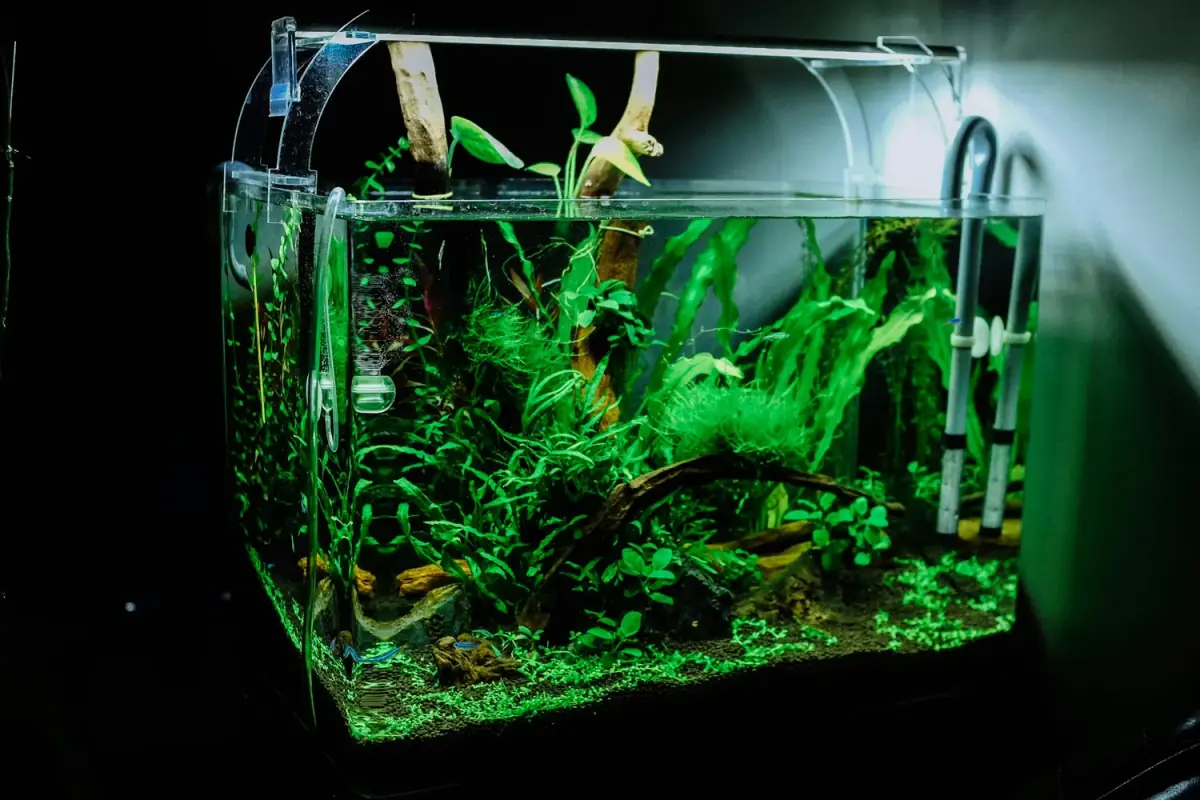
What you need from the start
A starter kit with tank, filter, heater and light is often cheaper than buying the parts separately, and gives you parts that fit together. Make sure the filter and light are big enough for the tank. The Norwegian Food Safety Authority (Mattilsynet) recommends a tank of at least 100 liters, with enough capacity in light, filter and pump.
Filter
The filter is the most important piece of equipment in the aquarium. It removes dirt from the water, but most important of all, the filter media is home to the bacteria that break down ammonia and nitrite. Read Cycling: the nitrogen cycle explained for why.
There are several types:
- Internal filters hang inside the tank. They are simple and cheap, and work well in small and medium tanks.
- External filters, or canister filters, sit in the stand below and have plenty of room for filter media. They are good for larger tanks and stay clean longer.
- Sponge filters are driven by an air pump. They are gentle on small fish and shrimp, and are used a lot in fry and quarantine tanks.
A common rule of thumb is that the filter should pump the tank's volume three to five times an hour, but it varies with the fish. Some fish want strong flow, others calm water.
Heater and thermometer
Most tropical aquarium fish need warmth. Mattilsynet writes that the right temperature is usually somewhere between 22 and 28 degrees, depending on which fish you keep. A heater with a thermostat keeps the temperature steady.
- Choose the right size. A common rule is about one watt per liter, a little more in a cold room.
- Have a separate thermometer. The thermostat on the heater is not always accurate, and a thermometer shows you that everything is as it should be.
- Place the heater where the water flows, for example by the filter outlet, so the heat spreads.
Some fish, like goldfish and certain coldwater species, do not need a heater in a normally heated room.
Light
The light shows off the fish, and the plants need it to grow. LED lighting is standard today. It uses little power and gives off little heat.
- Use a timer, so the light is on for the same time every day. Around 7–8 hours is a good starting point.
- More light is not always better. Light the plants do not use feeds algae.
Read more in Lighting: how long and how bright.
Water conditioner and test kits
Water conditioner neutralizes chlorine in tap water, and most also bind heavy metals. Some water suppliers disinfect with UV, but many use chlorine, at least at times, so water conditioner is cheap insurance. Use it at every water change.
Test kits let you see what you cannot see: ammonia, nitrite, nitrate and pH. You need them most during cycling. Drop tests are more accurate than strips. Read How to test your water.
For water changes
- A gravel vacuum, a hose with a tube at the end, which sucks up water and dirt from the bottom at the same time
- A bucket used only for the aquarium, so no soap residue ever gets into the water
- A net to catch fish and remove leftovers
- An algae scraper or magnetic scraper for the glass
What can wait
A lot of equipment is nice to have, but not needed from the start:
- A CO₂ system and fertilizer are only needed if you want many demanding plants. Easy plants do fine without. See Easy plants for beginners.
- An air pump is rarely needed when the filter moves the water surface well, but is useful for a sponge filter and in hot spells.
- An automatic feeder is rarely necessary, and must be set carefully so the fish do not get too much. See Vacation: what do I do with my fish?.
Buy good basic equipment rather than lots of equipment.