Ich (white spot)
The most common disease in aquarium fish. How to recognize it, why it shows up, and how to get rid of it.
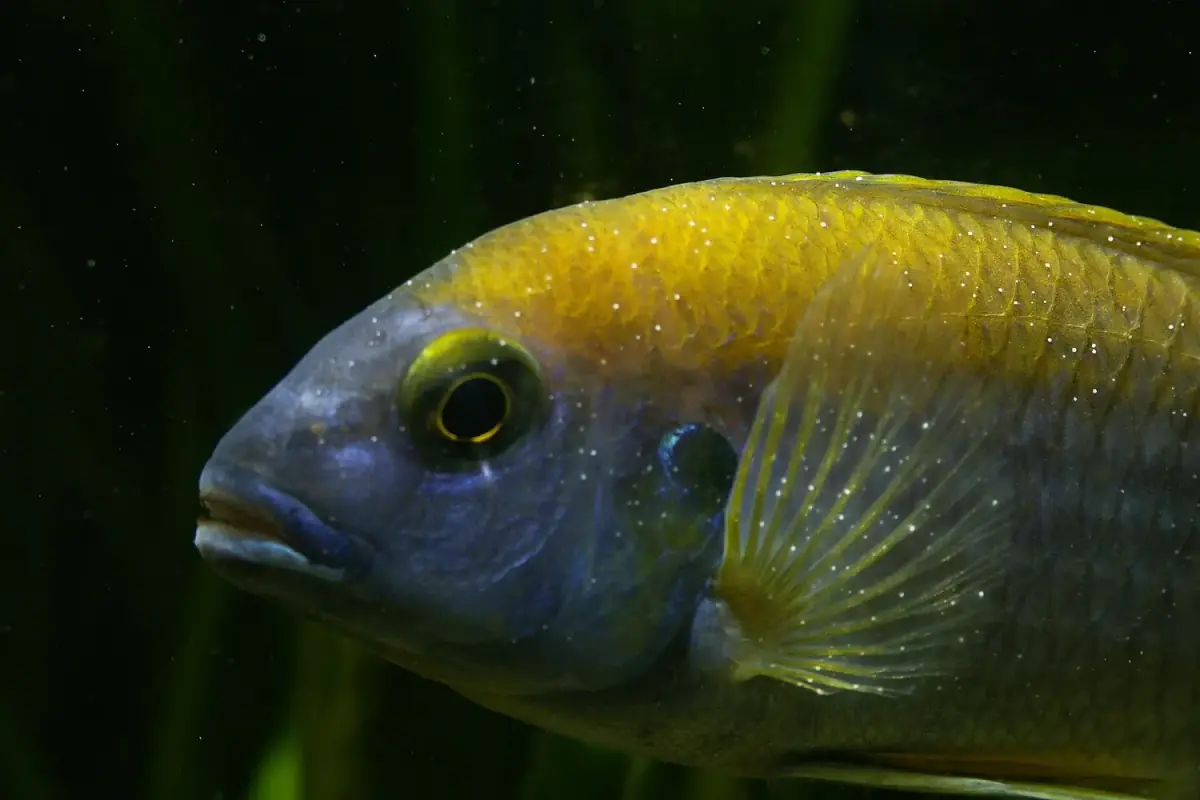
What it looks like
Ich is the disease aquarists run into most often. The fish gets small white spots about a millimeter across, like salt or sugar sprinkled over it. The Norwegian Food Safety Authority (Mattilsynet) describes how they often show up on the tail fin first and later all over the fish.
Other signs are that the fish:
- rubs itself against rocks, plants or the bottom
- keeps its fins clamped to its body
- breathes fast or stays near the surface, when the parasite is on the gills
- eats poorly and seems sluggish
Early on there may be only a few spots, and they are easiest to see on the fins. Look closely at all the fish, not just the one you noticed.
What it is
Ich is caused by a single-celled parasite called Ichthyophthirius multifiliis, often just called "Ich". It has a life cycle in three stages, and that is what makes it hard to get rid of:
- On the fish, the parasite burrows in under the skin and grows. These are the white spots. Here it is protected, and medicine cannot reach it.
- On the bottom, it drops off the fish and forms a cyst, where it divides into hundreds of new parasites.
- In the water, the new parasites swim around looking for a fish. Only here can medicine kill them, and they die on their own if they do not find a host within a short time.
The whole cycle takes just a few days when it is warm, and several days to more than a week when it is cold. So the spots you see today are not what you are treating. You are treating the ones that drop off tomorrow.
Why it shows up
The parasite most often comes with new fish, and Mattilsynet notes that newly bought fish are especially prone to it. It can also come with plants or water from another aquarium.
A healthy fish in good water can often cope with a few parasites. What makes ich flare up is stress: a drop in temperature, a move, poor water or an aggressive tankmate. That is why the disease so often appears a few days after new fish have been added.
How to treat it
Treat the whole aquarium, not just the fish with spots. The parasites swim freely, and all the fish have them.
- Test the water and do a water change. Mattilsynet writes that it often helps to change some of the water and check that the temperature is right. If you vacuum the bottom at the same time, you remove many of the cysts.
- Use an ich medicine from a fish store, and follow the instructions carefully. Ask at the store if you are unsure.
- Take activated carbon out of the filter if you have it, or it will remove the medicine.
- Make sure there is good aeration. Both heat and many medicines lower the oxygen in the water.
- Keep going for a few days after the last spot is gone. The parasites still on the bottom need time to hatch and be caught. Stopping too early is a common reason the disease comes back.
Heat
Many people raise the temperature a few degrees, gradually over a day, to make the parasite go through its life cycle faster, so the medicine gets it sooner. Only do this if every species in the aquarium can handle it. The species profile in the app tells you which temperature each species does well in.
Shrimp, snails and sensitive fish
Many ich medicines contain copper or other substances that are toxic to shrimp and snails. If you keep them, choose a medicine that says it is safe for invertebrates, or move them out while you treat. Some fish, especially scaleless catfish, also tolerate less medicine. Read the package carefully, and ask at the store before using medicine on such fish.
How to avoid it
- Quarantine new fish in a small tank of their own for a few weeks before they go into the aquarium. There is more in Quarantine for new fish.
- Avoid sudden temperature changes, including during water changes. New water should be the same temperature as the water in the aquarium.
- Keep the water good. As Mattilsynet writes, it is easier to prevent disease with good care and good water quality than to medicate sick fish.