How to set up an Asian aquarium
Two aquariums from Southeast Asia: calm forest streams and peat swamps with soft, brown water, and fast mountain streams with cool, oxygen-rich water.
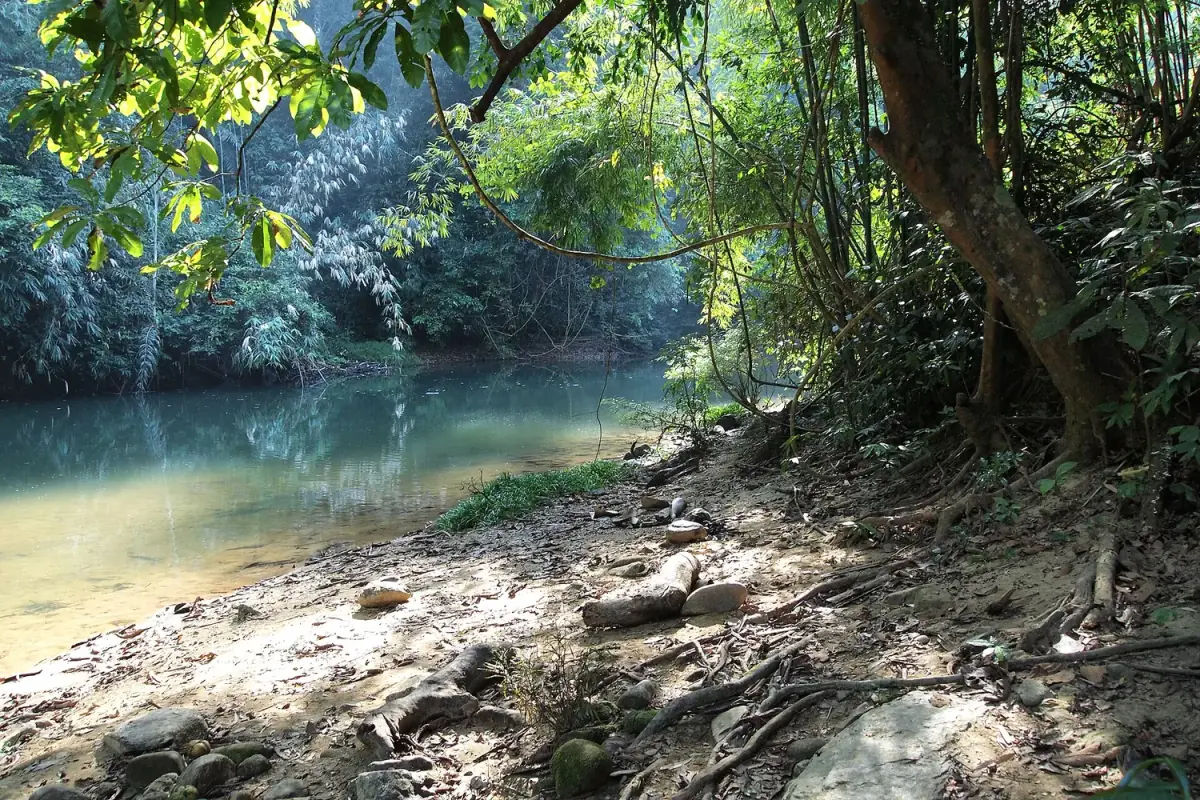
Southeast Asia has two completely different kinds of water, and both make a fine aquarium. One is calm forest streams and peat swamps with soft, brown water and subdued light. The other is fast mountain streams with cool, clear water and strong flow. Choose one of them and stick to it. Read more about what a biotope is in Biotope aquariums: a slice of nature.
Water
The forest streams and peat swamps of Malaysia, southern Thailand, Singapore, Sumatra and Borneo have soft water. Leaves and wood break down on the bottom and stain the water brown, a bit like weak tea. The temperature is 24–28 °C. The water has low hardness, and in the brown peat swamps the pH can drop all the way to around 4. You do not need to copy that.
In the aquarium, aim for 24–28 °C, pH 6–7 and a hardness below 10 dGH. If you want a deeper color, the pH can go down toward 5 with leaves and roots, but no further.
Tap water varies a lot by region, from very soft to very hard. If yours is soft, you often have a good starting point; if it is hard, mix it with RO water gradually, testing as you go. Either way, check the pH and hardness of your tap water before you choose species, see How to test your water.
The mountain streams, such as the Thu Bon River in Vietnam where Sewellia comes from, are cooler, 20–24 °C, with pH 6–7.5 and a hardness of 1–10 dGH. The water is clear because it runs over rock and gravel, not through forest. It is rich in oxygen, and that is exactly what the fish need.
Bottom
In the forest stream, the bottom is dark, fine sand, ideally with a layer of leaves on top. The leaves gather along the edges and break down slowly. They add color, and they provide bacteria and tiny organisms that fry live on. Replace the leaves when they are brown and soft, not on a fixed schedule.
In the mountain stream there is gravel, rock and bedrock, with no fine sediment. The current washes the silt away. In the aquarium, choose coarse gravel that does not compact. Siphon the gravel during water changes, because leftover food that ends up between the grains rots quickly.
Decor
The forest stream needs roots, tree trunks and dense plants that give shade and cover. New roots release a lot of tannins, which can make the water darker than you wanted. Soak the wood for a day or two before it goes into the aquarium, and most of the color will be gone.
The mountain stream needs smooth rocks of different sizes, placed so the current flows over and around them. Make hollows under the rocks where the fish can hide when the flow is strong. The current is part of the decor here: a circulation pump that creates strong movement at the surface.
Plants
Asia gives us some of the easiest plants there are, see Easy plants for beginners. Cryptocoryne, Java fern and Java moss suit the forest stream and cope with subdued light. Hygrophila and rotala are beautiful in a brighter tank, but want more light and nutrients. Java fern and anubias should be attached to rocks or roots, not buried. The rhizome must sit free, or it rots.
Aquatic plants rarely grow in the mountain stream. The fish live on algae and biofilm on the rocks. If you want plants, choose tough species such as Java fern, anubias and crinum, and let them be a touch, not the main feature.
Light
The forest stream has medium to subdued light. The peat swamps are dark under the trees, and floating plants can shade things a little more. Bright light brings more algae and spoils the mood of the forest stream. See Lighting: how long and how bright.
The mountain stream has brighter light. Algae and biofilm on the rocks are an important part of the diet for many of the fish, and they grow best in sunlight.
Typical fish
In the forest stream, the harlequin rasbora (Trigonostigma heteromorpha) is the classic fish. It is kept in a school, and the aquarium should be at least 60 × 30 cm, about 54 liters. Danios, gouramis, bettas and botia loaches also fit here. Kuhli loaches thrive on the bottom.
In the mountain stream, it is Sewellia lineolata, a hillstream loach that needs cool water with plenty of oxygen and flow. The aquarium should be at least 75 × 30 cm, about 68 liters, and well cycled before the fish move in. Sewellia climbs the glass, so the lid must fit tightly.
Things to watch out for
- New wood and fresh leaves stain the water a lot. Soak wood, and hold off on new leaves until the water is the way you want it.
- Soft water can swing. When leaves break down and the carbonate hardness is low, the pH can drop fast. Test weekly, and do a water change if it falls.
- Hillstream fish cope poorly with heat. Above 24 °C in summer is a risk, especially without plenty of oxygen. Check the temperature of the room.
- Do not mix the two types in the same aquarium. They need different water, different flow and different temperatures.